
'India-US defence pacts are seen by many analysts as a subtle move to jointly contain China's growing militarism, especially in the strategic Indian Ocean Region.'

Unimaginative increments, persistent refusal of funds have turned the military into an underfed child scared to ask for a full meal.

Here's the full text of President Ram Nath Kovind's customary address to the joining sitting of Parliament on the first day of the budget session.

'If the dimensions of the strategic partnership worked out by India and the US seem like a grand alliance targeted at you-know-who, China had better realise that it has fathered it,' says B S Raghavan, a long time observer of China.
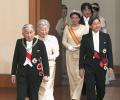
The emperor has no political power, yet he enjoys a unique place in Japanese society, notes Dr Rajaram Panda.

Pope Francis on Friday called upon the world community to put aside their "partisan interests and sincerely strive to serve the common good".

'This is the first time the US has formally recognised the threat India faces from terrorist organisations based in Pakistan.'

What must India do now?

Defence Minister Manohar Parrikar immediately ordered the navy chief to personally inquire into what this meant for India's maritime security.
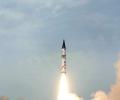
DRDO's latest test towards developing an anti-ballistic missile shield, to protect Indian targets against nuclear-tipped ballistic missiles fired from Pakistan or China will provide a technology that is akin to striking a bullet with a bullet, say Ajai Shukla

'You can never say never in politics.' 'We may still see the return of AAP, but hopefully not of the same abusive politics again,' says Shekhar Gupta.
The Indian Army and more recently the Indian Navy have already set up dedicated intelligence branches. It is surprising indeed that the IAF, where real time and timely intelligence is most vital for effective and safe prosecution of the air war, has still not done so itself, says Group Capt (retd) P I Muralidharan.

'The real test will be in defence-related deals, for instance the Javelin anti-tank missile: Is the US willing to co-develop something with India, on terms that will support the 'Make in India' initiative? Is there defence technology transfer? Or will it dump old junk on India?' asks Rajeev Srinivasan.

62 mass murders carried out with firearms across 30 US states. Of these, 12 were in schools, 19 at workplaces, the other 31 cases took place in shopping malls, restaurants, government buildings and military bases. The average age of the killers was 35, with the youngest only 11 years old. B S Raghavan on how the killings will continue until America confronts the urgent need for gun control.
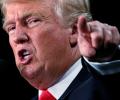
The US foreign and security policy establishment, says Ambassador M K Bhadrakumar, apprehends that Trump may compel them to exorcise the 'unipolar predicament', and bring foreign and security policies to reflect the desires and priorities of the American public.
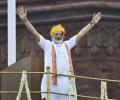
Following is the full text of Prime Minister Narendra Modi's address from the ramparts of the Red Fort on the 73rd Independence Day.

Did we miss the DeepState's Brazil Model in action in India in 2004 and 2009, asks Rajeev Srinivasan.

'We had never imagined that the prime minister could use such language to win votes.' 'I was under the impression that the prime minister is a very knowledgeable man, but I was amazed to find that he doesn't know that India's Constitution.'

The Mars mission is overwhelmingly irrelevant to space science and won't advance the frontiers of knowledge. It will divert attention from the real technological challenges facing the Indian space programme, and will further distort our science and technology priorities, says Praful Bidwai.

'Ensuring through diplomatic means and in conjunction with strategic partners that India will not be required to fight a simultaneous two-front war with China and Pakistan.' Brigadier Gurmeet Kanwal (retd) lists what India must have in its national security strategy.

Drones are being sold by e-retailers like Flipkart and Snapdeal for less than Rs 40,000 apiece.

There are signs of China's external behaviour becoming more aggressive in the coming years. If that happens, strategic implications for neighbours having territorial disputes with China can become deeper and imperatives can rise for the former to counteract, says D S Rajan
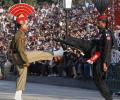
'Pakistan's capacity to carry a normal relationship with India doesn't exist.' 'The relationship with Pakistan is less important than several others.'

'I had to convince myself that I was steely enough to operate on a cold-blooded killer.' 'For all my medical experience, this was something I had never done!' 'If something happened to Charles, I knew my fate was sealed for me.' 'I would be called Doctor Death until I breathed my last.' 'Success was my only hope of escaping that fate.' A fascinating excerpt from heart surgeon Dr Raamesh Koirala's Charles Sobhraj, Inside The Heart Of The Bikini Killer.
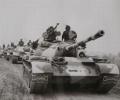
The 1965 war teaches us that war by escalation is a real possibility. Despite clear threats, Pakistan never believed that India will ever cross the international border. In the age of nuclear deterrence, this failure to deter Pakistan is the central lesson of 1965, says Colonel Anil Athale (retd).

The joint statement issued after Prime Minister Narendra Modi and President Barack Obama's first-ever summit is high on intent and ambition. Notably missing from the statement is India's refusal to be America's partner in its war against ISIS.

Moving ahead with their new mantra -- Chalein Saath Saath: Forward Together We Go -- Prime Minister Narendra Modi and United States President Barack Obama on Tuesday vowed to deepen cooperation in every sector for the benefit of global stability and people's livelihoods over the next ten years.

Excerpts from Prime Minister Narendra Modi's speech at the Combined Commanders Conference on board the INS Vikramaditya at sea, off the coast of Kochi.

Five months after he was assaulted by a mob and forced to chant 'Jai Bhawani, Jai Shivaji,' Assistant Sub Inspector of Police Yunus Shaikh will return to the police force on July 21. Shaikh relives the assault and its aftermath in this interview with Rediff.com's Prasanna D Zore.

New Delhi and Beijing are the only two regional capitals that have commented on US President Donald Trump's speech on August 21 outlining the way forward in Afghanistan. The Indian foreign ministry statement was effusive in praise, while the Chinese statement has been one of cautious and guarded hope. Delhi has identified itself with Trump's Afghan strategy, whereas the Chinese stance is calibrated -- observant and objective, keeping a distance, says Ambassador M K Bhadrakumar.

Ajit Doval, former chief of Intelligence Bureau and now head of Vivekanada International Foundation, continues his furious argument against any kind of CBI action against his former colleague Rajinder Kumar in the Ishrat Jahan fake encounter case of 2004.

In this industry, a company's strategy needs to be adaptable in order to keep up with the pace of change.
